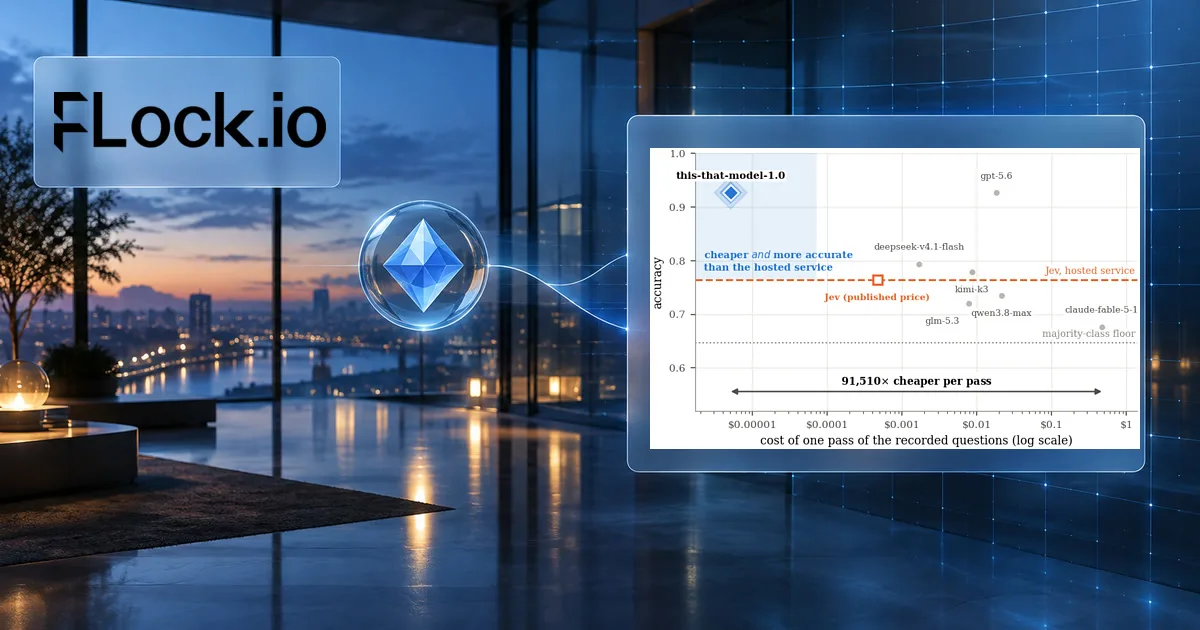
FLock.io has released this-that-model-1.0, an open-source decision model that runs locally and produces zero output tokens. The company said in a post on X that the model achieved a 94.1% success rate on its 68-question decision test.
On that recorded cohort of 68 questions across 17 states from a third-party hosted commercial decision service, the model posted 0.941 accuracy and a Brier score of 0.042, according to the project's GitHub repository. A Brier score measures the accuracy of probability forecasts.
FLock.io's model card compares the model's 0.941 accuracy with 0.926 for gpt-5.6, 0.794 for deepseek-v4.1-flash, 0.779 for kimi-k3 and 0.765 for the commercial baseline Jev. It also says the model returns an index and probability in about 30.9 milliseconds on a consumer GPU, at roughly $0.000014 per pass, compared with $0.018 for gpt-5.6 and $0.042 for Jev. Those results are self-reported in FLock.io's model card.
The comparison is specific to that 68-question test. On a separate spatial benchmark released by the authors, this-that-model-1.0 scored 0.839, below gpt-5.6's 0.897.
The model is available under the MIT license. It was authored by Zehua Cheng, Wei Dai and Jiahao Sun of the University of Oxford and FLock.io, and is adapted from decider-2b, which uses the Apache-2.0 license.
FLock.io Ltd was incorporated in the UK on April 11, 2022, according to a UK Companies House filing. The company describes its platform as decentralized AI infrastructure that combines federated learning with blockchain verification, allowing organizations to train models without centralizing raw data.
It has raised $11 million to date, including a $6 million seed round in March 2024 and a $3 million strategic round in December 2024.