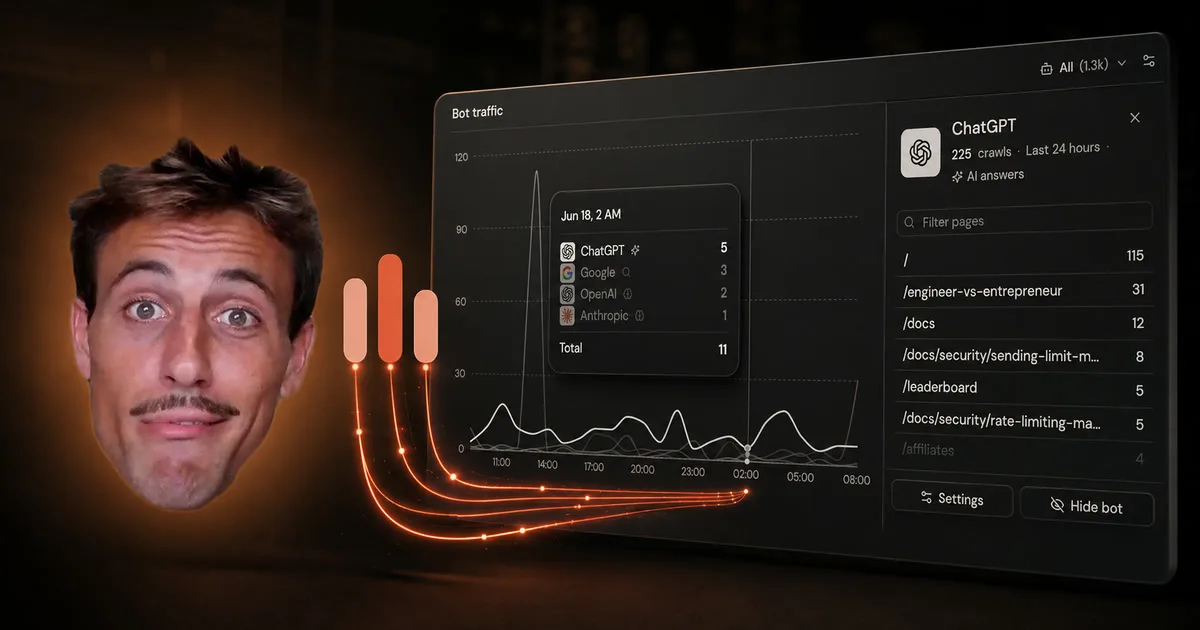
On Sept. 6, 2026, Marc Lou, creator of DataFast, said in a post on X that he had updated the company’s MCP server to support questions about bot traffic. Agents can ask which AI bots crawled a site during the week, whether ChatGPT is fetching pages to answer users and which companies requested its /llms.txt file.
Lou also said every DataFast feature can now be used through its API and MCP. The company dated the bot-traffic addition Sept. 3, when its changelog said the interfaces could access the bot information and controls available in the dashboard.
Agents can check an account’s allowance, change crawler settings and create or rotate request-authentication tokens. Changes require confirmation, while existing API-token permissions and website-access rules remain in effect.
DataFast introduced its Bot traffic dashboard card on July 1. The feature uses a separate server-side tracker, published as @datafast/ai-crawl, rather than the company’s regular browser analytics script. DataFast said server-side tracking is necessary because AI crawlers often request raw HTML without running frontend JavaScript.
The product groups bot activity into AI answers, indexing and training. DataFast’s public directory lists 62 crawlers, comprising 16 answer fetchers, 14 indexing crawlers, 19 training crawlers and 13 other bots. The tracker also records known-bot requests for robots.txt, llms.txt, llms-full.txt and sitemap files.
DataFast launched its MCP server on July 18. Codex, Claude Code, Cursor, ChatGPT and other compatible clients can use natural-language requests to examine analytics and handle selected website operations. The server uses Streamable HTTP at https://datafa.st/api/mcp.
Its tool reference covers bot-traffic summaries, pages, usage, settings and tokens, alongside analytics, visitors, goals, funnels, alerts, mentions, notes, websites and account management. The REST API and MCP tools use the same route handlers, giving them matching authentication, permissions, validation and results.
DataFast added X and Reddit mentions and manual chart notes to both interfaces on Sept. 5. On Sept. 6, it added custom goal-parameter breakdowns and made OAuth available for MCP.
Some operations remain outside MCP. Website deletion, payment-provider connections and purchases of extra bot-traffic capacity stay in their respective dashboards.
Starting Sept. 15, Bot traffic tracking includes 100,000 accepted requests per account in each billing cycle. An optional 1 million additional requests costs $9 a month. Reaching the allowance pauses bot-traffic ingestion, but regular web analytics continues.
DataFast connects website analytics with payment-provider data to attribute revenue to traffic sources. Its broader product includes goals, funnels, visitor journeys and real-time visitor intelligence.